Mayan Display Font for Handmade Creators
If you’ve ever spent hours tweaking a label, reworking an invitation layout, or second-guessing whether your printable wall art feels “just right,” you know how much weight the right display font carries. That’s why I reached for Mayan the moment I saw it — not as another decorative typeface, but as a quiet confidence booster for my physical products and digital designs alike.
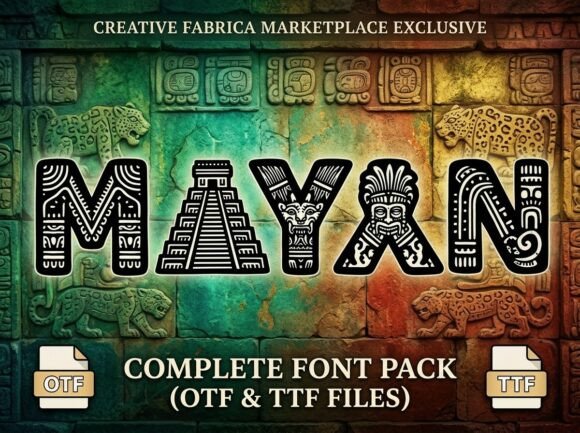
Mayan isn’t subtle — and it’s not meant to be. It’s a bold, expressive display font with strong visual personality: clean yet organic lines, balanced contrast, and just enough artistic nuance to feel intentional without sacrificing readability. Think of it as the kind of font that holds its own on a rustic wooden sign *and* looks sharp scaled down on a 1.5-inch product tag. Its charm lies in its clarity — even at small sizes, the letterforms retain their character, making it unusually versatile for a decorative typeface.
I use Mayan across nearly every part of my shop workflow. For candle labels, I pair it with a simple sans serif for ingredient lists — Mayan handles the brand name and scent title beautifully, giving each jar instant shelf presence. On greeting cards and invitations, it adds warmth and distinction without veering into overly ornate territory. I’ve printed it on kraft paper tags for boutique soap sets, cut it from vinyl for farmhouse-style wall signs, and embedded it into SVG files for Cricut users who want ready-to-cut wedding welcome boards. It works especially well for seasonal packaging — think “Hand-Poured • Small Batch • Made With Love” stamped across holiday gift boxes or “Summer Collection” on reusable tote bags.
One thing I appreciate is how Mayan bridges aesthetics and practicality. Unlike some display fonts that blur or pixelate when scaled, Mayan stays crisp in mockups, print-ready PDFs, and cutting-machine previews — whether I’m designing for Silhouette Studio or exporting high-res PNGs for digital downloads. For stickers under 2 inches, I keep phrases short (3–5 words max) and avoid tight kerning adjustments; the font’s natural spacing holds up well even when laser-cut or die-cut. And because it’s designed for impact, not body text, I reserve it for titles, names, slogans, and decorative headings — never long paragraphs.
Pairing Mayan is intuitive. I often layer it with a relaxed handwritten font for quotes or personal notes (like “You’re Invited” + a gentle script for the date and time), or anchor it with a clean, neutral sans serif like Montserrat or Inter for supporting details. For wedding stationery, I’ll combine Mayan with a delicate serif like Playfair Display — the contrast feels elevated but grounded. When designing planner pages or printable bundles, I use Mayan for section headers (“Weekly Goals”, “Gratitude Log”) and switch to a legible sans for checkboxes and prompts. It’s also surprisingly effective in minimalist logo design for small studios — think coffee roasters, ceramic studios, or botanical skincare brands where strength and authenticity matter.
Before downloading, I always check what’s included: standard OpenType (.OTF) and TrueType (.TTF) files (essential for both desktop and web-based design tools), plus any stylistic alternates or ligatures. While the product description highlights its artistic elements and strong visual personality, I’ve found the base character set covers English, Spanish, and French diacritics — helpful for bilingual greeting cards or international Etsy listings. No extended Cyrillic or Asian language support, so I steer clear of multilingual packaging unless I’m layering in a secondary font for those sections.
Here’s what matters most when you’re selling: Mayan comes with a commercial license that covers physical products, digital downloads, templates, SVG files, and client work — no extra fees or attribution required. That means if you’re bundling it into a Canva template pack, embedding it in a Procreate brush set, or printing it on mugs sold via Printful, you’re covered. Just remember: you can’t resell the font file itself or claim it as your own design asset. But using it to elevate *your* handmade goods? That’s exactly what it was made for.
Real talk: Not every project needs Mayan. If you’re designing a medical brochure or a legal disclaimer page, reach for something more restrained. But for anything where emotion, identity, and attention matter — a hand-stamped tea box, a bridal shower banner, a limited-edition poster series, or even a Shopify store banner — Mayan delivers presence without pretense. It doesn’t shout; it stands. And in a crowded marketplace where handmade creators compete on feeling as much as function, that kind of quiet authority makes all the difference.
Whether you're building a cohesive brand identity across labels, social media graphics, and packaging — or simply choosing one premium font to anchor your next printable collection — Mayan earns its place not just as a decorative choice, but as a reliable, readable, commercially smart tool in your creative toolkit.